February 2, 2025 · Prohibitions and AI literacy
Unacceptable-risk practices are banned. Organizations must support AI literacy among the people who use AI systems.
Regulation (EU) 2024/1689 · AI Act
Your team already uses ChatGPT, Copilot or Gemini. Audexa helps you see which AI is in use, the risk of each use, which obligations apply to you and how to prove it, with human review always as the final step.
What the AI Act requires
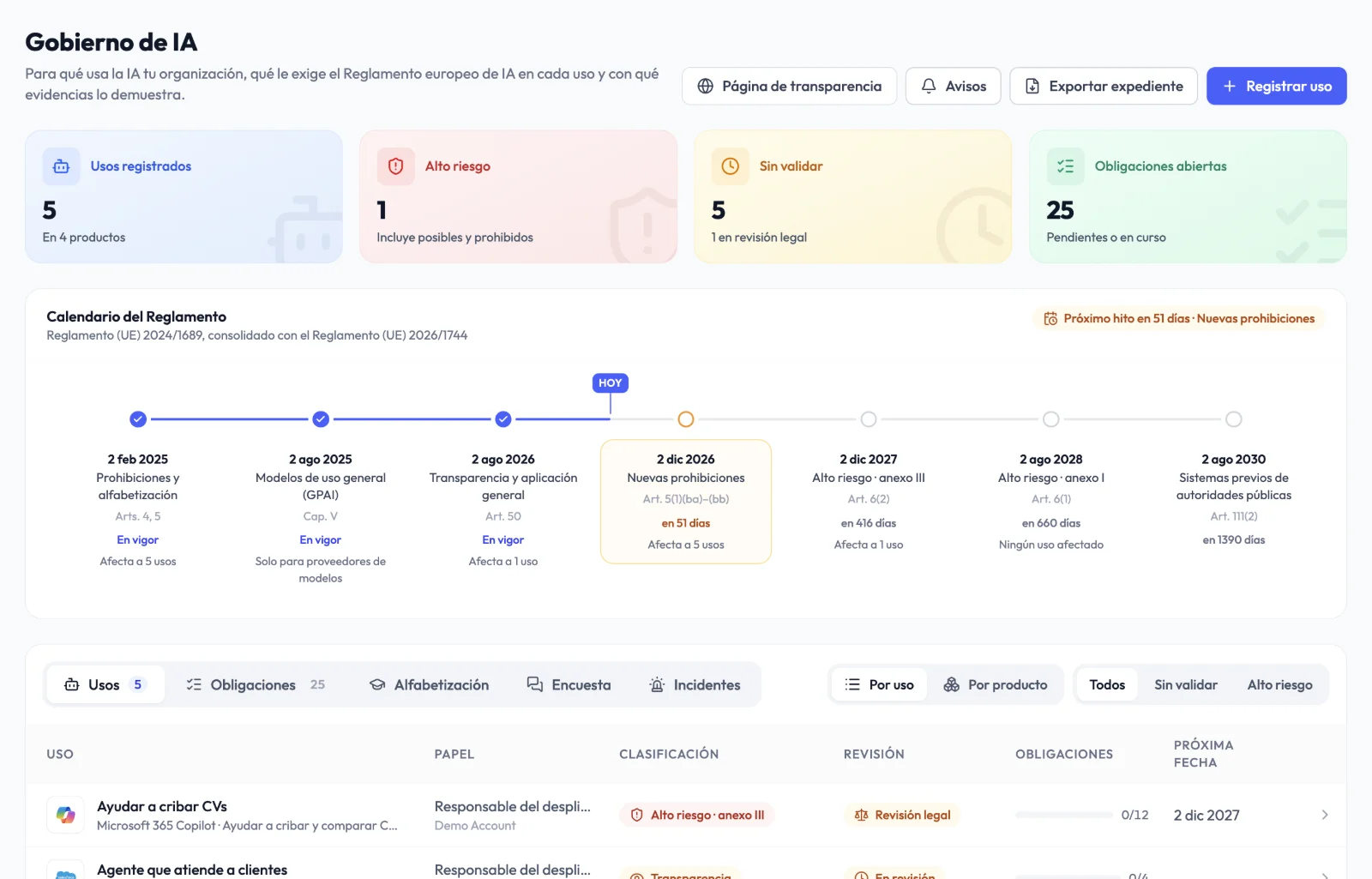
Regulation (EU) 2024/1689 regulates AI according to its risk. The Digital Omnibus (Regulation (EU) 2026/1744), in force since July 27, 2026, postponed the high-risk obligations but kept those that already applied.
Unacceptable-risk practices are banned. Organizations must support AI literacy among the people who use AI systems.
Obligations for providers of general-purpose AI models, and the governance and penalties regime takes effect.
Article 50 obligations: inform people when they interact with AI and label generated or manipulated content.
High-risk systems in areas such as employment, education, credit or critical infrastructure, following the Omnibus postponement.
AI built into already-regulated products, such as medical devices, machinery or toys.
The regulation provides for fines of up to €35 million or 7% of worldwide annual turnover for prohibited practices, with lower amounts for other infringements.
Sources: Regulation (EU) 2024/1689 (EUR-Lex) · AI Digital Omnibus, Regulation (EU) 2026/1744 (Cuatrecasas)
How Audexa helps
An inventory of uses, indicative classification, obligations backed by evidence and external transparency, in a single module.
Know which AI is used and for what.
Add each use from 24 templates with what the provider declares: training, data residency and DPA.
An alert when the software inventory contains AI tools without a registered use.
Send questionnaires via single-use links and save the answers as evidence.
Understand the risk of each use.
Scope, prohibited practices, Annexes I and III, the Article 6(3) exception and transparency, with the articles cited.
A review workflow in which an accountable person validates the classification, never their own.
Each obligation has a date and an owner, and it closes only with approved evidence.
Internal proof and external transparency.
Staff surveys with no account required, plus coverage of the signed AI use policy.
An incident register with the Article 73 reporting deadlines and alerts before they expire.
A public page with your logo and colors, embeddable on your website, with a QR code and PDF.
Some features depend on your plan and active modules.
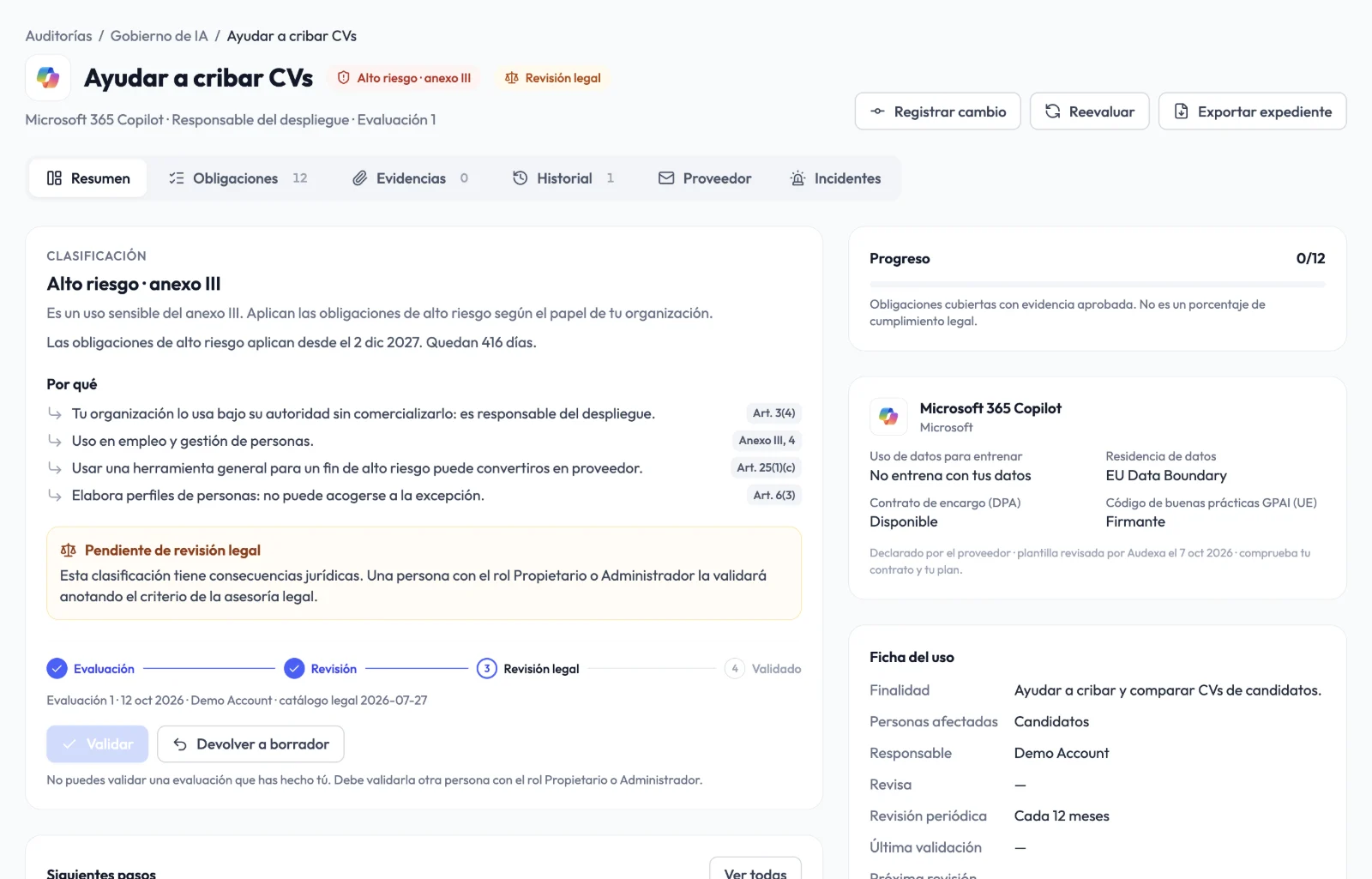
Risk classification
The wizard walks through the regulation's scope, prohibited practices, the high-risk annexes, the Article 6(3) exception and transparency obligations. Each result shows the articles that support it and remains pending human validation.
AI literacy and policy
Launch surveys on AI use, AI literacy and awareness of your internal policy. Employees answer with a code sent by email, without creating an account, and you see aggregated results.
Transparency
Generate a public transparency page listing your AI uses, designed with your logo and colors. Only what an accountable person approves is published, and never prohibited or out-of-scope uses.
How it works
Add tools from templates and detect the AI nobody had registered.
Get an indicative classification with cited articles and have an accountable person validate it.
Close obligations with evidence, measure AI literacy and publish your transparency page.
Frequently asked questions
Yes. By using AI in your business you are a deployer: you must support AI literacy among the people who use it and, depending on the use, meet transparency obligations or, if the use is high-risk (for example, recruitment), the specific obligations that will apply from December 2027.
Following the Digital Omnibus (Regulation (EU) 2026/1744), the rules for Annex III high-risk systems apply from December 2, 2027 and those for Annex I systems from August 2, 2028. The prohibitions, AI literacy and Article 50 transparency obligations were not postponed.
No. The classification is indicative: it shows the supporting articles and always requires validation by an accountable person. For complex decisions we recommend legal support.
Audexa includes the ISO/IEC 42001 audit with 94 controls, and AI Act obligations are linked to its controls so your compliance work also supports an AI management system.
The AI Act is an EU regulation, so it applies directly in every Member State. Each Member State designates its own supervisory authorities and sets the rules on penalties, and the status of those national measures varies by country. Check the situation in the countries where you operate.
The AI Governance module is available on the Premium and Diamond plans.
Request a demo
In a 30-minute demo we register a couple of real uses, classify them and show you the obligations, surveys and transparency page.