
ICT risk management framework
A documented framework, approved and reviewed by the management body, which bears ultimate responsibility for ICT risk.
Regulation (EU) 2022/2554 · DORA
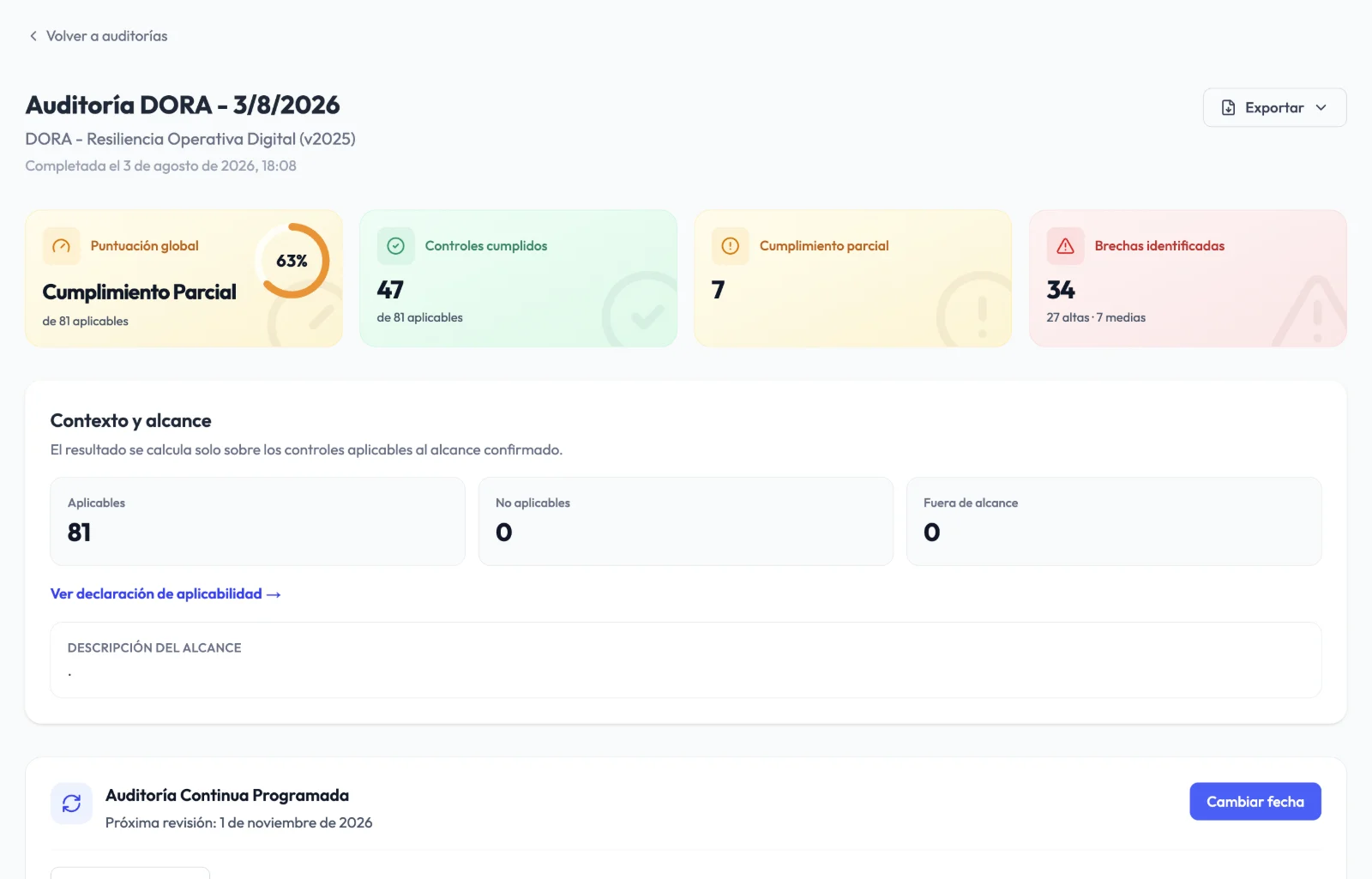
DORA has applied since January 17, 2025. Audexa brings together the assessment of all 81 controls, your ICT suppliers and contracts, the register of information and the evidence supervisors ask for, in one place.
What DORA requires
The regulation applies directly to banks, payment and e-money institutions, investment firms, asset managers, insurers, crypto-asset service providers and other financial entities. Compliance is supervised by national competent authorities and the European Supervisory Authorities (ESAs).
A documented framework, approved and reviewed by the management body, which bears ultimate responsibility for ICT risk.
Classification and reporting to the supervisor: initial notification within 4 hours of classification (no later than 24 hours after detection), an intermediate report within 72 hours and a final report within one month.
A testing program proportionate to size and risk, plus threat-led penetration testing (TLPT) for designated entities.
A third-party strategy, minimum contractual clauses, exit strategies and control of concentration risk.
An inventory of all arrangements with ICT providers, following the EU implementing templates, submitted to the supervisor.
Arrangements for securely sharing cyber threat intelligence with other financial entities.
Sources: Regulation (EU) 2022/2554 (EUR-Lex) · Implementing Regulation (EU) 2024/2956 (EUR-Lex) · INCIBE: reporting major incidents under DORA (in Spanish)
How Audexa helps
Assessment, ICT third parties, evidence and reports connected, so every requirement has an owner, a date and proof.
Know where you really stand against the regulation.
81 controls across 14 domains, with interpretation guidance, suggested evidence and acceptance criteria.
Exclude controls that don't apply to your entity, with a justification that stays with the results.
46 links between DORA and ISO 22301 to build on the continuity work you already have.
Suppliers and contracts with the data DORA needs.
Supplier record with legal name, tax ID, validated LEI, country, criticality and dependencies.
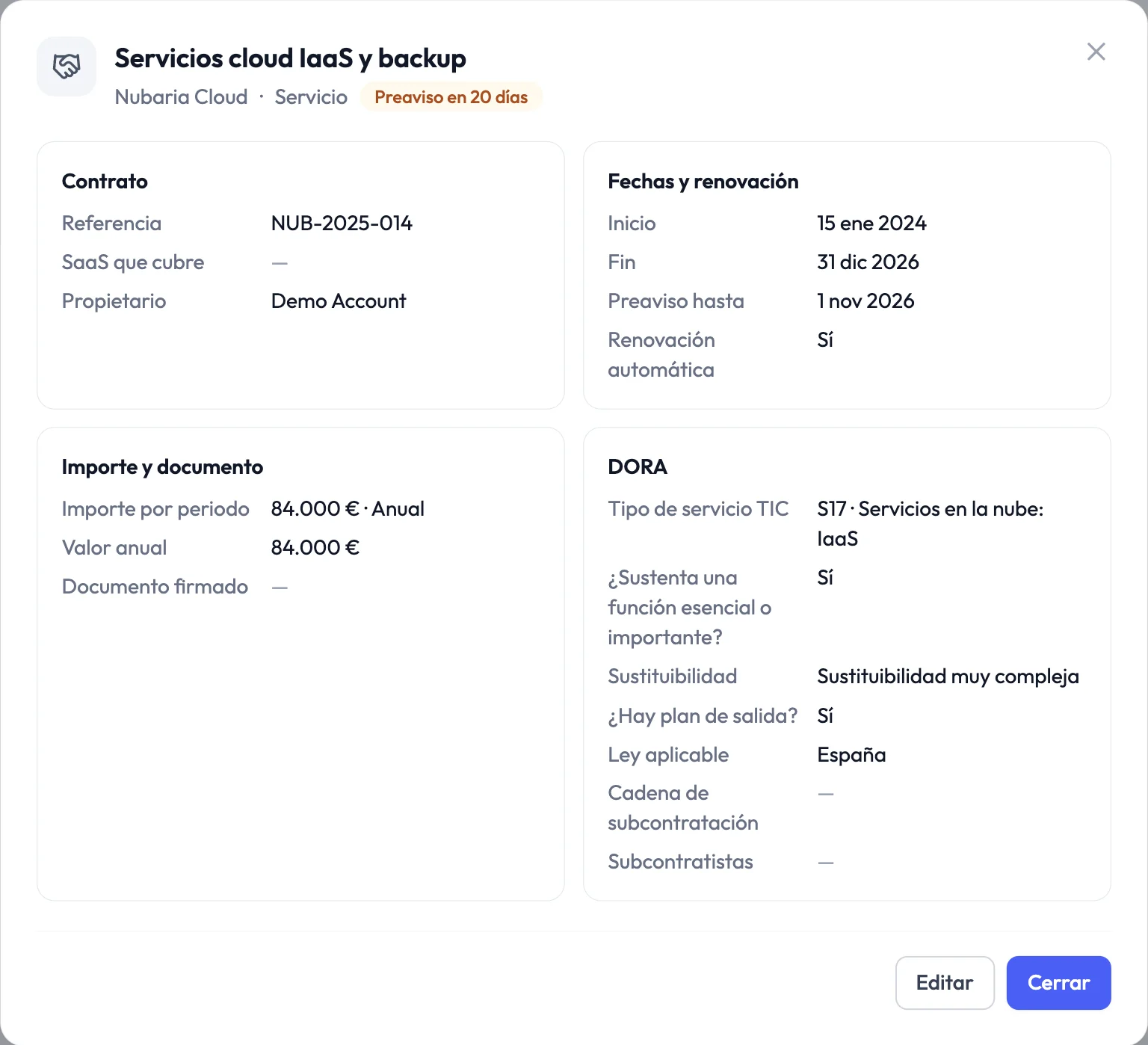
ICT service type, critical or important function, substitutability, exit plan, governing law and subcontractors.
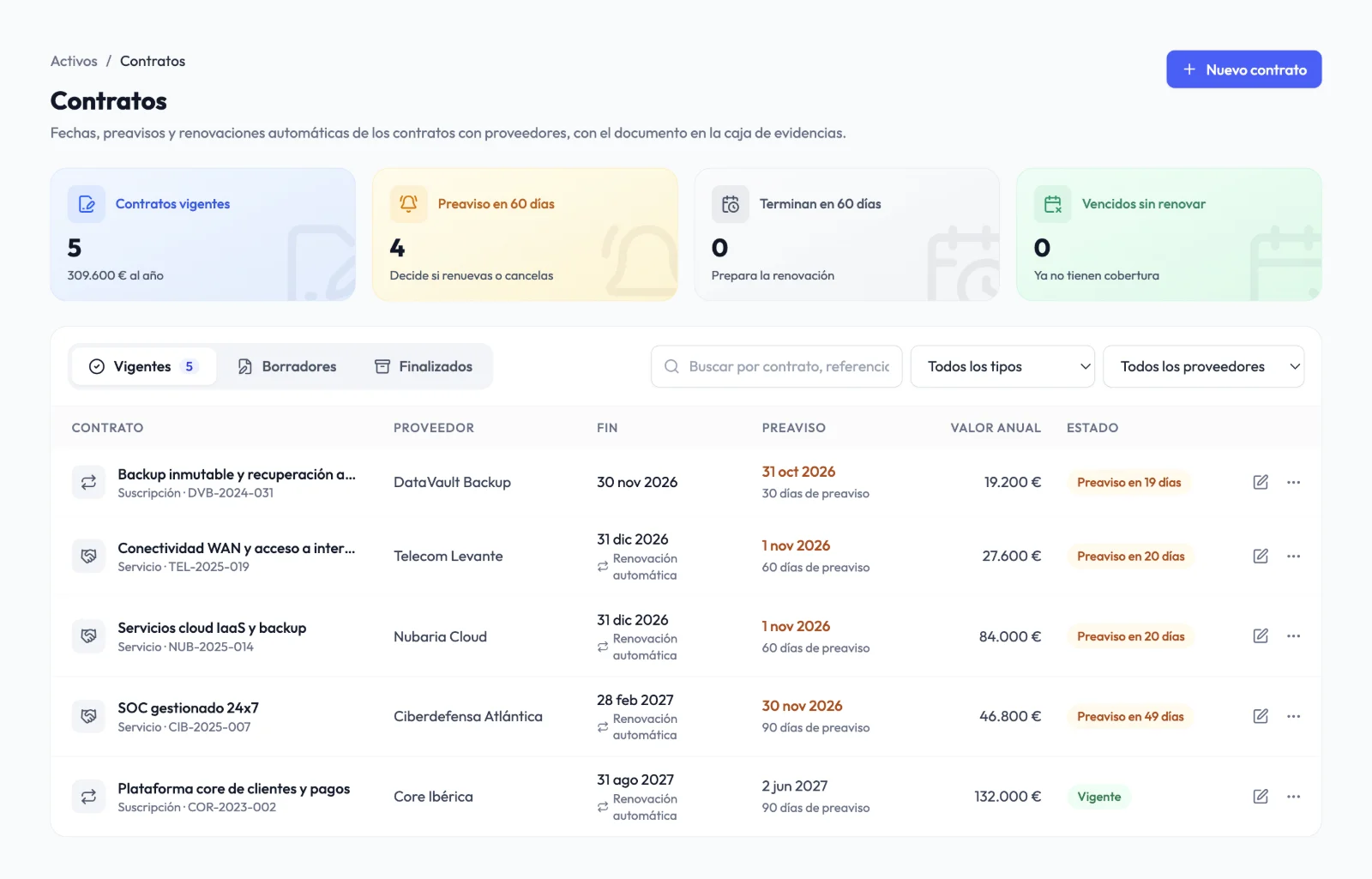
Alerts 90, 60 and 30 days before the notice deadline and the expiry date, also shown in the calendar.
Have ready what the supervisor will ask for.
Export the “Register of information (DORA)” sheet to Excel, with one active contract per row.
Templates for digital operational resilience, resilience testing, threat intelligence and reporting to authorities.
Executive and technical report with progress over time, gaps, risks and a roadmap.
Some features depend on your plan and active modules.
Register of information
Every contract with an ICT provider feeds the register. Audexa exports a sheet with the columns of the EU implementing templates, ready to review and adapt to your supervisor's submission format.
ICT third parties
Suppliers, contracts, SaaS and dependencies in a single inventory. Audexa warns you before a notice period runs out and flags what needs attention: personal data without a DPA, MFA not enabled or critical suppliers without an owner.
ICT incidents
The DORA audit assesses incident classification, severity criteria and the deadlines for initial, intermediate and final reports. Gaps become tasks and a ready-to-approve procedure for reporting to authorities.
How it works
Complete the DORA audit, justify what doesn't apply and get gaps prioritized by weight and risk.
Load suppliers and contracts with DORA data and get the register of information ready.
Assign tasks, approve policies, gather evidence and share the report with management.
Before and after
Register of information
Excel rebuilt by hand every year
Exported from live contracts
Contract notice periods
Discovered too late
Alerts at 90, 60 and 30 days
DORA gaps
Static consulting report
Tasks with owners and expected evidence
Policies
Documents with no version or signature
Approval and signature workflow with history
Continuity
Duplicated work with ISO 22301
Cross-framework mappings
Frequently asked questions
To around twenty categories of financial entities: credit, payment and e-money institutions, investment firms, asset managers, insurers and reinsurers, crypto-asset service providers and market infrastructures, among others. ICT providers to these entities also receive requirements through their contracts.
Audexa exports an Excel sheet with the fields of the EU implementing templates, built from your contracts and suppliers. It helps you prepare and review the data; the technical submission format is set by each supervisor.
No. Audexa assesses your classification and reporting process and helps you document the procedure and close gaps, but reports are submitted through your competent authority's channels.
For financial entities, DORA acts as sector-specific legislation that takes precedence over NIS2 for ICT risk management and incident reporting. Even so, Audexa lets you assess both frameworks and reuse evidence.
The DORA framework is available on the Premium and Diamond plans. In the demo we review what fits your number of users, contracts and suppliers.
Audexa runs on EU infrastructure, with role-based access, two-factor authentication and activity traceability.
Request a demo
In 30 minutes we show you the DORA audit, ICT contract management and the register of information export.